Journal

|

Heritage

Historic Ocean Liners: Décor in Motion

Long before the Orient Express took to the seas with the Corinthian, the great ocean liners had already made travel a territory of invention. Aboard these giants of the Atlantic, architecture, decorative arts, naval engineering, and the art of hospitality converged with a shared ambition: to transform a crossing into a total experience.

These vessels were far more than means of transport. They were floating manifestos. Architectures in motion. Miniature cities launched upon the ocean, where one dined, danced, slept, wrote, conversed, contemplated the sea, and observed the art of living itself. In their lounges, smoking rooms, dining rooms, and first-class cabins, shipping companies staged much more than comfort: they asserted an idea of taste, progress, and national prestige.
From the mid-nineteenth century onward, the major European shipping companies opened regular routes between Europe and the Americas. In France, the Compagnie Générale Transatlantique, soon associated with the celebrated French Line, connected Le Havre to New York and turned its ships into ambassadors of French art de vivre. For several decades, the ocean liner became the link between continents, an instrument of migration, trade, mail delivery, and gradually, leisure travel.

At the dawn of the twentieth century, competition between nations and companies intensified. Ships had to be larger, faster, more comfortable. On the North Atlantic, the race for prestige was also a race for image. Technical power became a political, economic, and cultural language. An ocean liner no longer carried passengers alone: it carried a vision of the world.

In the early decades, War, the world changed. Migratory flows diminished, uses evolved, and shipping interiors still drew heavily on historic styles. On board, references to Louis XVI, Louis XIV, and Renaissance aesthetics abounded, as though the crossing had to reassure a land-based bourgeoisie by recreating, at sea, the codes of a familiar interior. But after the First World companies sought to appeal to a new clientele of leisure travellers, diplomats, artists, industrialists, and wealthy voyagers. The ocean liner became a floating palace.

It was in this context that a decisive turning point emerged: the Exposition Internationale des Arts Décoratifs et Industriels Modernes, held in Paris in 1925. The exhibition revealed a generation of architects, decorators, artists, and ensembliers who broke away from pastiche and historical revival. Geometric forms, taut lines, precious materials, stylisation, and a taste for synthesis: Art Deco offered shipping companies a new language. Modern, French, spectacular.

The Compagnie Générale Transatlantique immediately understood what was at stake. At the time of the construction of the Île-de-France, its president, John Dal Piaz, expressed a conviction that read almost like a manifesto: in art, to produce is not to copy, but to create. From that moment on, the ocean liner became the ground for a fertile encounter between maritime industry and contemporary creators.

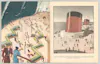
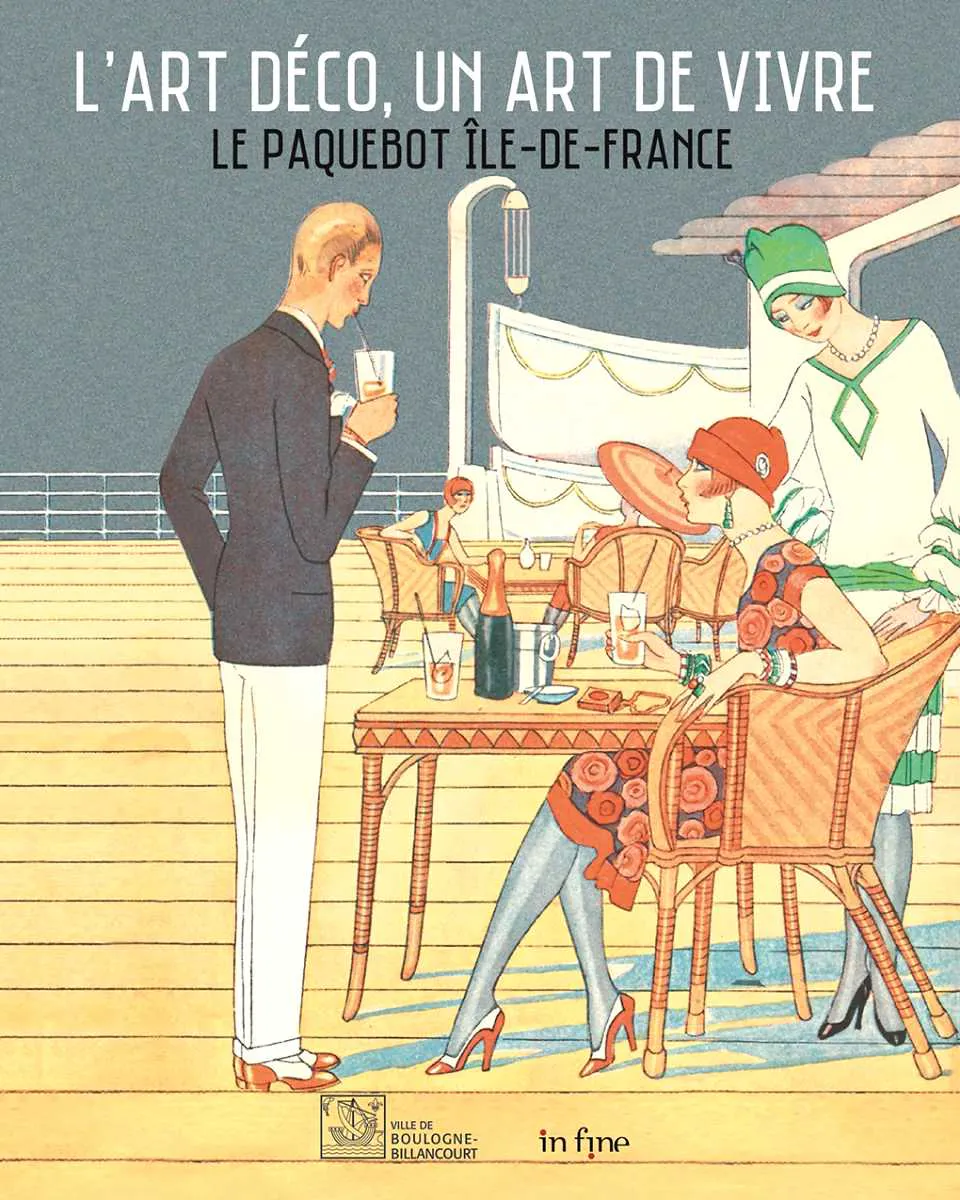
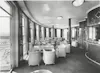
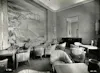
Launched in 1927, the Île-de-France marked this rupture. Often considered the first great French Art Deco ocean liner, it inaugurated a new way of conceiving ship interiors. First-class spaces no longer sought to reproduce the salons of a château or a private mansion. They invented a language of their own, capable of bringing together modernity, luxury, and comfort. Pierre Patout, Jacques-Émile Ruhlmann, Louis Süe, André Mare, René Lalique, and Raymond Subes were among the creators associated with this adventure. The ship became a showcase for French creation.

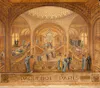
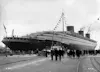
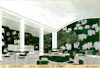
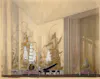
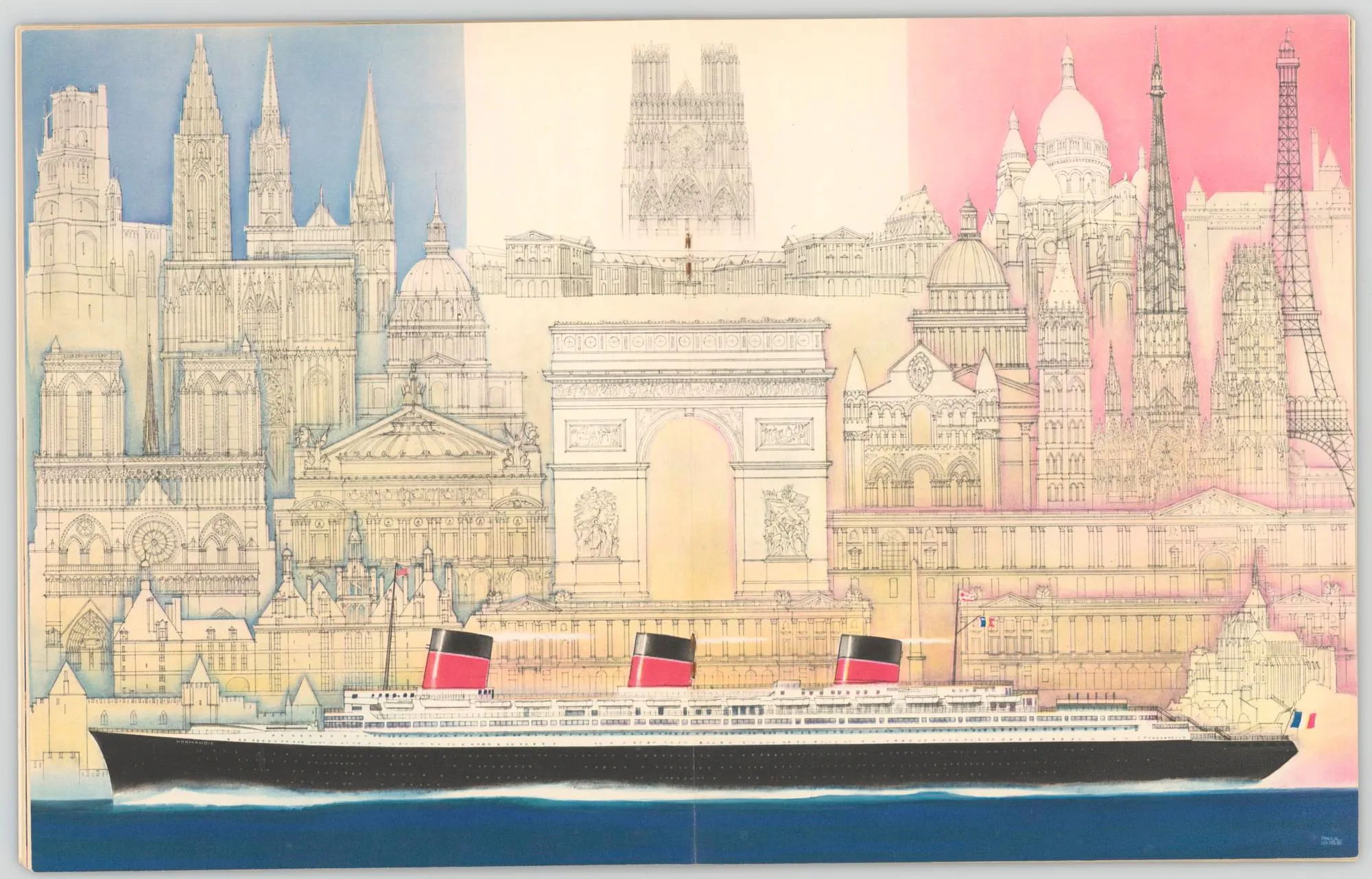
A few years later, L’Atlantique, and above all the Normandie, brought this ambition to its height. Launched in 1935, the Normandie was far more than a naval achievement. It was a total masterpiece: at once an engineering feat, a national symbol, and an Art Deco manifesto. On board, volumes reached an unprecedented monumentality. The grand salon, dining room, smoking room, staircases, light fixtures, decorative panels, lacquers, tapestries, ironwork, and tableware composed a scenography of exceptional scale.

The greatest names took part: Jean Dunand for lacquer, Jean Dupas for the great decorative schemes, Raymond Subes for metalwork, René Lalique for glass, Auguste Labouret, Jacques-Émile Ruhlmann, Pierre Patout, Roger-Henri Expert, Jean-Maurice Rothschild, and many others. Each brought his own language, yet nothing could be considered in isolation. Aboard an ocean liner, the arts are not merely superimposed: they must be integrated. Space is constrained, the ship is in motion, circulation is precise, and materials must respond to specific requirements. The decorative work can only exist in constant dialogue with technique.

This may be where the profound modernity of these ocean liners resides. They required decorators and artisans to think differently. A piece of furniture could not simply be beautiful: it had to be stable. A light fixture could not simply be spectacular: it had to withstand, illuminate, and integrate with the architecture. A panel, a door, a handrail, a table, or a partition belonged both to an overall composition and to a world of constraints. The ocean liner demanded that dream and rule, splendour and function, imagination and engineering be held together.

This exacting context gave rise to an essential figure: the ensemblier-décorateur. These creators were not merely designers of forms. They understood trades, materials, and workshops. They engaged in dialogue with master artisans, ironworkers, glassmakers, cabinetmakers, lacquerers, upholsterers, and silversmiths. They knew that the beauty of an ensemble depends as much on the overall vision as on the precision of a joint, a proportion, or a finishing detail.

It is this culture of the total work of art that makes the great ocean liners so fascinating today. They are no longer merely objects of maritime history. They belong to the history of design, interior architecture, decorative arts, and luxury. They speak of an era in which modernity was not conceived against craftsmanship, but with it; in which technique was not meant to erase décor, but to allow it to exist under new conditions.

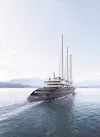
From this perspective, the Corinthian belongs to a lineage. Not through imitation, but through filiation. Like the great ocean liners of the twentieth century, the first Orient Express ship is born from a dialogue between technical power and the imagination of travel. It carries a vision: that of Maxime d’Angeac, who reinterprets the spirit of Orient Express without freezing it in nostalgia. It mobilises crafts, materials, gestures, and savoir-faire capable of transforming a vessel into a place of experience.

The connection between Art Deco ocean liners and the Corinthian is therefore not merely aesthetic. It is deeper. It lies in a shared ambition: to make travel a complete art. To create spaces that accompany movement without being subjected to it. To bring memory and innovation into coexistence. To design décors capable of withstanding time, use, and the sea, while preserving their power to inspire wonder.

Yesterday, the Île-de-France and the Normandie carried the genius of French architects, decorators, engineers, and artisans across the Atlantic. Today, the Corinthian opens a new chapter in this history. A chapter in which luxury travel returns to the sea, in which technique seeks to disappear, and in which art craftsmanship remains at the heart of the experience.

For a great ship, when conceived in all its dimensions, is never merely an object in motion. It is a world. And in that world, every detail matters.

Rinck · depuis 1841
L’Assistant Rinck
Échange confidentiel