Journal

|

Heritage

L'Objet Extraordinaire

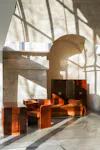
On the occasion of L’Objet Extraordinaire, organised by the Carré Rive Gauche association, Rinck presents an exceptional Art Deco ensemble dating from 1931, attributed to Eugène Rinck, a leading figure of the third generation of the family house.

The ensemble was rediscovered following a call from Madame Vauclair of Galerie Vauclair to Valentin Goux, after she had acquired the furniture from a fellow antique dealer. Comprising a bookcase, a desk, a daybed and an armchair, the ensemble gradually recovered its history through extensive research carried out within the house archives.

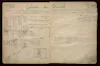
Order books, preparatory drawings, handwritten annotations and cutting lists made it possible to authenticate the pieces and precisely trace their origins. Little by little, the archives revealed far more than a provenance: they brought back to life an entire decorative language, a pivotal moment in Rinck’s history, and the emotional memory of those who commissioned, designed and crafted these pieces nearly a century ago.
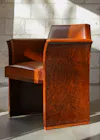

“When you look at the shape of the armchair, it could easily have been designed in 2025 by a young designer.” Valentin Goux, President & Artistic Director of Rinck

©Ayka Lux- Say Who

©Ayka Lux- Say Who

What immediately strikes one about this 1931 ensemble is its modernity.

The lines are bold, the volumes perfectly balanced, and ornament reduced to its essential expression. While many designers of the period still retained decorative reflexes inherited from Art Nouveau, Eugène Rinck embraced a more radical approach: a precise, functional vocabulary, almost minimal in its relationship to ornament.

The walnut burr veneer, with its extraordinarily dense and vibrant grain, becomes a decorative motif in itself. Nickel-plated bronze and brass elements introduce a luminous modernity, while the subtle curves of the daybed and armchair soften the architectural rigor of the compositions.

For Valentin Goux, this ensemble also represents a defining moment in the aesthetic history of the house:

“We are clearly looking at one of the very first complete Art Deco ensembles created by Rinck. There is a genuine stylistic evolution here — almost a rupture — since until then the company had produced highly ornate pieces. Here, we are confronted with a design language driven by efficiency, without the temptation to add decorative flourishes as a bridge to Art Nouveau, as many other creators of the period still did. It is fascinating to see how Maurice Rinck, who was still very young at the time, grasped the essence of a highly modern French Art Deco and began to deploy it within Rinck.”

©Oskar Proktor

©Oskar Proktor

The rediscovery of this ensemble also reveals a profoundly human story.

The Rinck archives still preserve direct traces of its making: preparatory sketches, order books, cutting lists, handwritten annotations and clients’ names appear throughout the house’s historical records.

One of the drawings for the daybed notably bears the inscription:

“Daybed made for Mr Fayel.”

An almost intimate detail, suddenly transforming the historical object into a living presence.

This direct relationship between the archives and the pieces themselves continues to shape the house’s perspective on its own heritage. At Rinck, archives are not viewed as static documents, but as active material — capable of engaging in dialogue with the present.

At Rinck, archives are not regarded as static documents, but as a living material — one that remains in constant dialogue with the present.

Rinck model book dating from the 1930s.

Rinck model book dating from the 1930s.

For L’Objet Extraordinaire, the 1931 ensemble enters into dialogue with another defining period in Rinck’s history: the 1970s, through the re-edition of the TR-73 chair.

First presented in 1973 at the Salon National des Beaux-Arts at the Grand Palais, this avant-garde creation — then named Trèfle — marked the last historical contemporary collection developed by the house under the direction of Gérard Rinck.

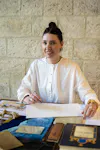
Bertille Goux, directrice des collections

Bertille Goux, directrice des collections

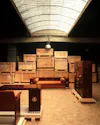
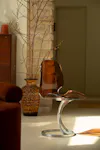
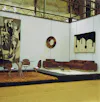
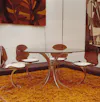
In the scenography imagined by Bertille Goux for the rue de Beaune gallery, the TR-73 chairs are displayed on pedestals, almost as autonomous sculptures. Their airy, graphic presence responds to the warmth and density of the Art Deco ensemble.

“I wanted to place a 1931 ensemble and a 1970 chair in dialogue, allowing them to resonate with one another: two archival pieces, two powerful presences, and two manifesto objects playing with curves through entirely different languages.”

This deliberate confrontation between two eras also reveals something deeper about the identity of the house. “We move forward, we take risks, but we reject nothing. ”- Valentin Goux

Founded in 1841, Rinck belongs to that rare lineage of houses whose history continues to nourish the present.

Through this presentation at Carré Rive Gauche, the house is not simply celebrating its heritage: it is affirming a unique way of inhabiting time — where archives become a source of creation, where eras converse with one another, and where objects continue to transmit the gestures, sensibilities and intuitions of those who imagined them.

As Bertille Goux summarises:

“Our perspective is different because we are able to position ourselves within a long history and engage with it. It is an extraordinary strength for a brand identity, but also a memory that must be honoured.”

Rinck stand at the Salon National des Beaux-Arts, Grand Palais — 1973.

Rinck stand at the Salon National des Beaux-Arts, Grand Palais — 1973.

Read more articles

A history of the smoking room

It was a requisite room in the mansions and elegant dwellings of yesteryear, now reminiscent of a bygone era of club chairs, smoking jackets, and sparkling social lives : the smoking room.

Where have all the ensembliers décorateurs gone ?

If you follow us on any social network, or if you have already read any coverage of Rinck, or if you had the opportunity to read the special issue ofConnaissance des Artsmagazine that featured our company, you are sure to have noticed at least one thing: Rinck calls itself an “Ensemblier Décorateur.”

Exploring the Watercolor World of Morgane Guerry

Enter the world of illustrator and watercolorist Morgane Guerry, through her two collaborations with Rinck. From painting a ceiling to creating an original folding screen, Morgane reveals an artistic process where limits are often made to be pushed, questioned and finally transcended.

A Common Visual Language: From Sketch to Technical Drawing

In the world of artistic creation, drawing holds a central place. It is the starting point of every work, a visual language that transcends materials to bring imagination to life. In this video series, explore how drawing, in all its forms, guides the transformation of spaces and objects.

Rinck · depuis 1841
L’Assistant Rinck
Échange confidentiel