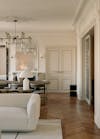
A Parisian interior reinterpreted

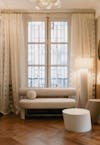
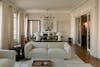
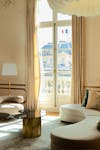
In Paris’s Golden Triangle, a 220 sqm Haussmannian apartment — complete with a service room — has found its rhythm again. Rinck’s mission was not to alter its envelope, but to revisit the way it is lived in: reorganising functions, refining circulation, restoring coherence to its uses, without erasing the heritage woven into its fabric.

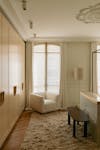
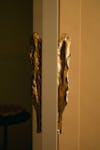
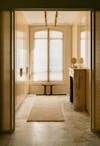
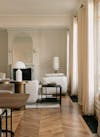
The signs of the place were already present: herringbone parquet, marble fireplaces, mouldings, cornices, finely chiselled bronze details. They were preserved. Rather than opposing these elements, the project chose dialogue: a contemporary vocabulary, calm, defined by straight-grain walnut, ash, bleached oak, satin finishes, and gentle tonalities. Intentionally minimal furniture, conceived in the background, allows the volumes to breathe.
The intention was not to impose a spectacular gesture, but to clarify: modernise the way the space is used, structure light, and render the home legible.
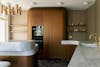
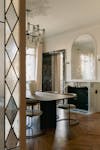
No major structural intervention was made. The floorplan was rebuilt in successive gestures, responding to the real life of its inhabitants. The former dining room was opened to become a corner kitchen flooded with light; the former kitchen was transformed into a discreet TV lounge paired with a laundry room. This almost silent logic of displacement made it possible to redefine functions without altering proportions.

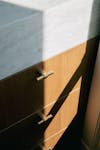
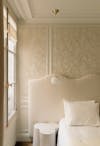
Each room was given bespoke elements designed specifically for it: wardrobes, headboards, benches, bathroom fittings, and wooden panels with carefully selected grain. Nothing demonstrative—rather a work of balance and fine adjustment, where equilibrium is favoured over effect.

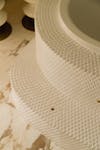
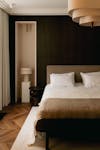
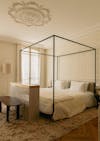
The master bedroom embodies this intent. It concentrates one of the project’s most significant gestures: bespoke staff and plasterwork. New cornices and rosettes were designed and crafted for the space; wall mouldings and sculpted motifs — including spandrels and stylised leaves — compose a plaster décor halfway between relief and textile. The room feels enveloped. Surfaces take on a slight haze, light clings to the volumes. Here, material speaks — it does not simply illustrate itself.

At the entrance, the dialogue between design and craftsmanship takes on another form. The master glassmakers of Au Passeur de Lumière created a series of stained-glass panels for the space, based on a Rinck motif originally designed for a textile collection published by Maison Thevenon. This frieze, inherited from the vocabulary of marquetry, finds a new interpretation in glass. Throughout the day, light passes through it, animating the space and immediately establishing the project’s DNA: a precise balance between heritage, design and savoir-faire.

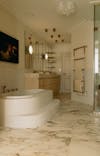
Material serves as the common ground for every intervention: Carrara marble for the kitchen, Calacatta Oro for the master bathroom, artisanal mosaics, oak parquet, decorative glass, gold leaf, matte lacquers, and bespoke mirrors. Each surface contributes to shaping the light rather than to mere ornamentation.

After four weeks of stripping out, seven months of work were required to orchestrate the whole: general contractor, marble worker, ceramicist, electrician, joiner, glazier, plaster craftsman, parquet installer, gilder, upholsterer — a constellation of coordinated gestures, each in its place, each in service of the space.

François Premier is not a renovated apartment. It is a rewritten way of inhabiting: heritage brought to a contemporary scale, without ostentation. A Parisian interior that is soft, quiet, timeless — true to Rinck’s ethos, where architecture elevates material, structures light, and tells a story through restrained décors and a mastered ornamental language.

Read more articles

Rinck: Tradition meets Innovation

For nearly two centuries, since its founding in 1841, Rinck has been the embodiment of artisanal excellence, flawlessly dovetailing time-honored tradition and cutting-edge invention. The company’s history is deeply rooted in exceptional craftsmanship, while ever keeping pace with changes in tastes, technologies, and the demands of the day.

In the Faubourg of Luxury: where art meets power

Beyond the fortifications of medieval Paris, one of the world’s most elegant urban districts was about to emerge from a swampy tract of land. The history of the Faubourg Saint-Honoré is, in and of itself, a synopsis of the birth and establishment of a lifestyle at once refined and rational, a stylish art de vivre to which greater Paris adheres to this day.

A History of Ornament

Ornament was a divisive subject in the 20th century, rejected by the modern movement as a sign of decadence, while considered by traditionalists to be a lingua franca uniting the realms of architecture and decoration. This debate has since been pushed aside by architectural post-modernism and contemporary – and deliberately eclectic – interior decoration. Let us look back upon a notion that is as old as humanity itself.

The Grand Hotels of Paris: Prestigious Commissions for Rinck

The finest hotels of Paris, the embodiment of French luxury since the 19th century, symbolize both contemporary sophistication and rare refinement. They have played host to the world’s most celebrated travelers. Rinck’s archives hold precious records of projects done for some of the greatest names in French hospitality.