Interview with Valentin Goux

On the occasion of Art Paris 2026, Rinck presents a scenography inspired by an imagined antiquity and conceived as a landscape. In this interview, Valentin Goux reflects on this approach, on the role of the sculpture La Nuit, and on the way objects come to life within space.

RINCK PRESENTS A STRONG SCENOGRAPHIC CONCEPT AT ART PARIS THIS YEAR. WHAT WAS THE INTENTION BEHIND IT?

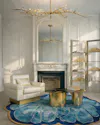
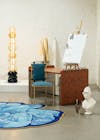
We wanted to think of the stand as a landscape — almost as an interior space to inhabit.
The idea was not to simply display pieces, but to create a composition where each element interacts with the others — furniture, sculpture, architecture.

WHAT DOES IT MEAN FOR YOU TO EXHIBIT AT THE GRAND PALAIS IN PARIS ?

It’s a very special place. There’s both a historical and a highly contemporary dimension, which resonates with the way we work. For us, it also represents a meaningful return. Rinck has exhibited at the Grand Palais several times throughout its history, notably in 1973, when its last contemporary collection was presented.

Coming back here today, in the context of Art Paris, creates a sense of continuity. It’s a way of extending that history while anchoring it in the present.

HOW DID YOU APPROACH THE SCENOGRAPHY OF THE STAND ?

We wanted to create a journey — a way for the eye to move through the space.
The platforms, the volumes, the rhythm — everything is designed so that the pieces are not simply displayed, but truly exist within the space.

What interests us is the relationship between the objects, more than the objects themselves considered in isolation.

THE PIECES SEEM TO ENGAGE IN A DIALOGUE WITH ONE ANOTHER. HOW DO YOU BUILD THAT COHERENCE ?

We never think of a piece on its own. There is always this idea of relationship, tension, and balance. Materials, lines, and proportions create correspondences. It is this dialogue that gives the whole its coherence.

THE SCULPTURE LA NUIT OCCUPIES A CENTRAL PLACE. WHY ?

Because it goes beyond the status of an object. It is a presence. It structures the gaze, provides an anchor within the space, and at the same time opens something more sensitive, more emotional.

WHAT DOES THIS WORK REPRESENT FOR YOU ?

It’s a very particular piece. It doesn’t communicate something directly — it suggests. It leaves room for interpretation. It was not about designing an object, but about embodying a fragment of life, of dream, of silence. That is what resonates deeply with us.

HOW DID THE COLLABORATION WITH SIMON BURET COME ABOUT ?

It started with a meeting, and then a desire to give him real freedom. We didn’t want him to adapt to our language, but rather to create a dialogue between his world and ours. It is this tension between two universes that makes the project compelling.

WHAT PLACE DOES ART HOLD IN YOUR WORK TODAY ?

It is central. Historically, the decorative arts have always been in dialogue with the fine arts. Today, we are seeking to rediscover that porosity — to break down boundaries.

WHAT WOULD YOU LIKE VISITORS TO FEEL WHEN DISCOVERING YOUR STAND ?

That they can pause. Take the time to look, to feel. And perhaps allow themselves to be carried by the space, rather than simply observing objects.

Poetic Accumulation and Illusions

In 2025, Rinck unveils its new furniture collection, Opus Memoria – an artistic exploration inspired by the vision of an illusory demiurge creator whose entire existence was devoted to accumulating works. Each piece embodies the imagination of an ingenious and multifacted artist working in the realms of music, painting, and sculpture, leaving behind a wake of unique artistic “totems.”

From Concept to Craft

Bertille Goux, designer at Rinck, discusses the research work on materials and finishes, revealing the behind-the-scenes of creation. Between aesthetic ambitions and technical constraints, she shares her ongoing dialogue with the workshops' artisans, their expertise, and their ability to bring our vision to life. An exploration of the subtle balance between innovation and craftsmanship, where each finish becomes a signature.

Exploring the Watercolor World of Morgane Guerry

Enter the world of illustrator and watercolorist Morgane Guerry, through her two collaborations with Rinck. From painting a ceiling to creating an original folding screen, Morgane reveals an artistic process where limits are often made to be pushed, questioned and finally transcended.

Rinck: A Century of Major Art Salons in Paris

For over a century, art and interior design fairs have served as vital venues for ensembliers décorateurs, providing incomparable showcases for displaying their style and savoir-faire. These major events – bringing together designers, creators, artisans, and artists, recognizing talent and setting the trends of each era – have shaped the very history of design and furnishings.