The Art of Stained Glass

Nolwenn de Kergommeaux, an exceptional master glassmaker, carries forward an ancestral savoir-faire in her Parisian atelier, Au Passeur de Lumière. Together with her team, she collaborates with Rinck, crafting bespoke stained-glass pieces designed specifically for some of our interior architecture projects. By shaping glass to capture and elevate light, her creations bring a timeless, luminous presence to the spaces they inhabit. Learn more about her craft in this interview.
In her Parisian atelier, Au Passeur de Lumière, Nolwenn de Kergommeaux works with a material we believe to be immobile. Glass does not bend, it does not forgive — it reveals. It is a material of light, patience, and precision, one that requires slowing down to understand its logic. “Stained glass is never a mere ornament. It exists through what it lets pass.”

The heart of the craft lies far from the imagery of ancient stained glass. Here, projects belong to contemporary architecture. Forms are simplified, transparencies expand, and nuances align with the volumes. The gesture lies in making an existing drawing converse with the light of the place in which it is installed. “A stained-glass piece can soften a space. It must never speak in the place of the room.”

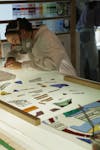
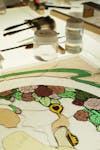
Craftsmanship begins when the drawing enters the workshop. Nolwenn does not “reinvent” the motif. She observes it, then translates it into material language: choice of glass, textures, shading, thickness. The atelier proceeds in successive layers — sometimes invisible, sometimes decisive. The cut glass aligns, the leaded joints adjust, the cames form a score. Each section is inspected and recalibrated if the light breaks too quickly or becomes lost within it.
“Our role is not to correct the drawing, but to give it substance.”

This dialogue between drawing and material takes on its full meaning in collaborations with Rinck. Interior architecture imposes a highly specific context: circulation, perspectives, rhythm of volumes, intensity of natural light. Stained glass never becomes a fixed picture. It integrates like a threshold or a breath — able to guide movement, soften a passage, or modulate an atmosphere.

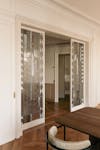
In the François Premier project, this balance took shape at the apartment’s entrance. The motif did not originate in Nolwenn’s atelier: it comes from Rinck’s studio — conceived by Bertille Goux for a textile collection, then redrawn by Clément Platret to be integrated into the interior architecture. Au Passeur de Lumière then translated it into glass, without altering its composition.

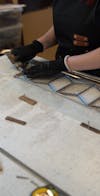
Time in the atelier is demanding. Gestures follow one another — cutting, leading, soldering, oxidation, cleaning. It is never an automatic process: each adjustment can call the achieved balance into question. Firing stabilises certain assemblies, yet remains a moment of risk; a minimal variation can shift chromatic intensity, weaken a corner, or alter a reflection.

“Here, we do not design in place of the architects. We listen to their intention, and we seek how light can make it legible. For François Premier, the stained glass had to be a breath — not a painting hung on the wall, but a surface that lets light pass through.”

When the piece finally takes shape, it is not yet an architectural element. It must be installed, and one must understand how it reacts to the space. The day’s shifting light alters its reading: the motif reveals itself at certain moments and fades at others. Stained glass is never the same under the morning sun as it is in the diffuse light of evening. That time belongs neither to the artist nor to the artisan — it belongs to the space that receives it.

Perhaps this silent relationship best embodies the art of contemporary stained glass: a discipline in which the hand is never there to sign, but to make an intention legible. To give volume to a drawing, to channel light, to offer a breath. And to let glass do what no other material knows how to accomplish: reveal space.

Read more articles

From Concept to Craft

Bertille Goux, designer at Rinck, discusses the research work on materials and finishes, revealing the behind-the-scenes of creation. Between aesthetic ambitions and technical constraints, she shares her ongoing dialogue with the workshops' artisans, their expertise, and their ability to bring our vision to life. An exploration of the subtle balance between innovation and craftsmanship, where each finish becomes a signature.

Rinck & Thevenon

The inspiration for the Rinck x Thevenon collection, imagined by the Rinck design studio, was the amalgamation of a number of the company's archives.

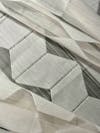
From the cubist wallpaper unearthed in a 1930s magazine to the panel in églomisé glass that Rinck presented at the 1939 New York World Fair’s to the marquetry friezes found on Rinck-crafted desks. A common thread wove it-self around and through these ins-pirations: a determination to make nature a vital unifying theme.

The Art of Ceramics

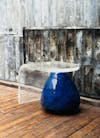
Discover the work of the ceramist Pauline Krähenbühl, who contributed to the creation of the Opus Memoria side table.

Timeless elegance and Parisian Art de Vivre

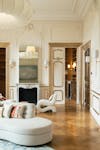
Located in the heart of Paris, in the Faubourg Saint-Honoré district, this apartment, nestled within a Haussmannian building, embodies the timeless elegance of Parisian architecture.

The renovation project involved a complete reconfiguration of the interior space, seamlessly blending the updated elements of a classic apartment with the selection and bespoke creation of contemporary furnishings.